
Categories
Selling Your Home, Selling At Woodrow Willson Owner House, Selling At Sutton House, Selling At Kennedy House, Selling At Essex House, FSBOPublished August 14, 2026
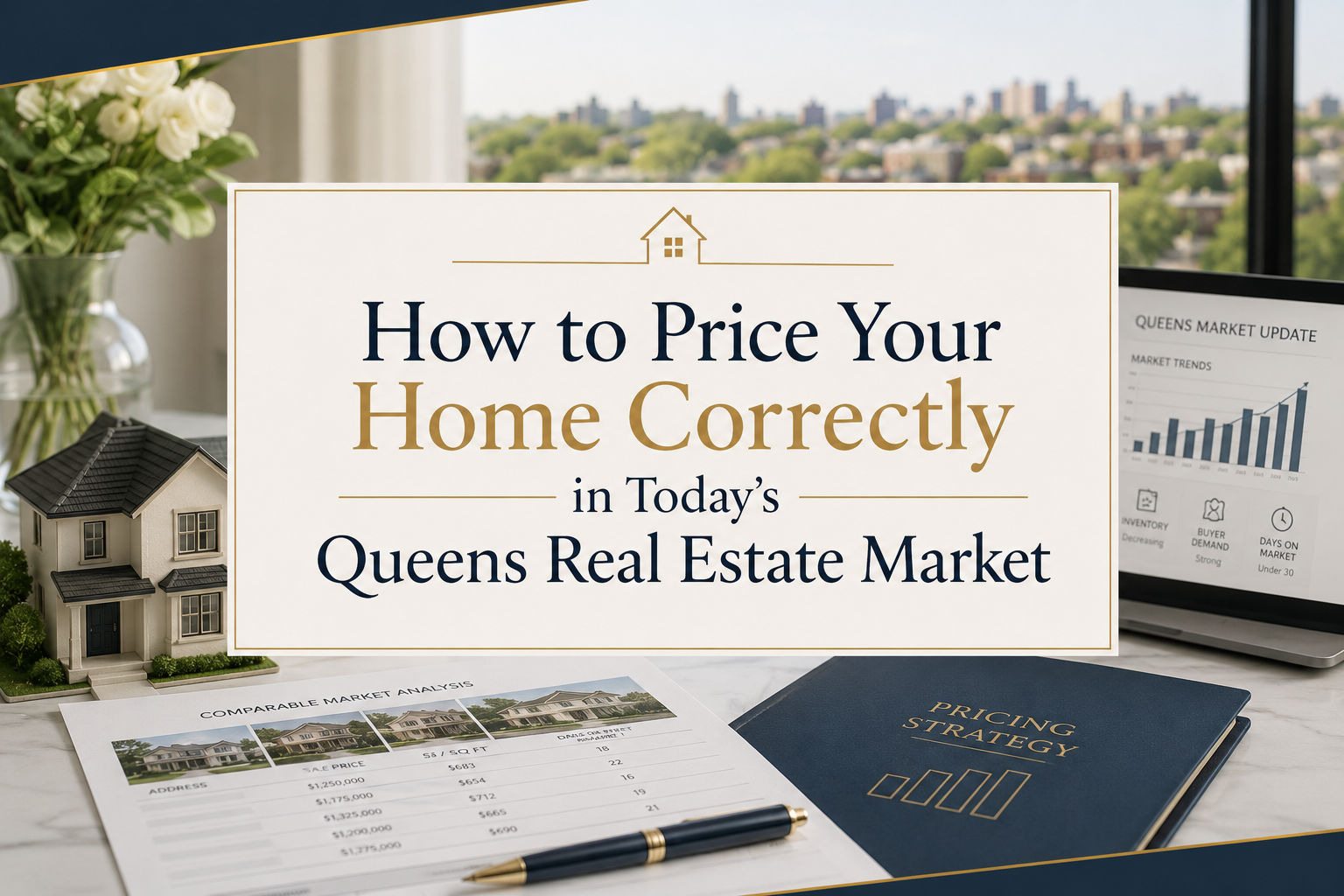
How to Price Your Home Correctly in Today’s Queens Real Estate Market

When you're selling a home, one of the biggest questions is also one of the most important:
What price should I ask?
Price too low, and you may worry that you're leaving money on the table.
Price too high, and your property may sit on the market, lose its initial momentum, require multiple price reductions, and eventually sell for less than it might have if it had been positioned correctly from the beginning.
The goal isn't simply to choose the highest asking price.
The goal is to position your home at the price that creates maximum buyer interest, generates strong offers, and ultimately puts the most money in your pocket.
After 19+ years selling real estate throughout Forest Hills, Rego Park, Kew Gardens, and surrounding Queens neighborhoods, I've learned that the right pricing strategy can make a significant difference in both the final sale price and the time it takes to sell.
The Most Expensive Mistake a Seller Can Make: “Let's Start High”
I often hear:
“Let's list it higher. We can always reduce the price later.”
It sounds logical.
Unfortunately, real estate doesn't always work that way.
When your property first comes on the market, it receives the most attention from buyers who have been actively searching and waiting for a property like yours.
This is your opportunity to make the strongest first impression.
If those buyers believe your property is significantly overpriced, many won't make a lower offer.
They simply won't make an offer at all.
Weeks later, you may reduce the price—but by then, the property is no longer a new listing.
Buyers begin asking:
- Why hasn't it sold?
- Is something wrong with the property?
- Why did they reduce the price?
- How motivated is the seller?
- Can we negotiate even lower?
Instead of negotiating from a position of strength, you may now be negotiating from a position of weakness.
The Danger of Becoming a “Stale Listing”
Every property has a marketing history.
Buyers and their agents can see when a property was listed, how long it has been available, and whether the asking price has been reduced.
The longer a property remains unsold, the more buyers may begin to question its value.
This is what sellers often refer to as a stale listing.
A property that should have generated excitement during its first weeks on the market may instead become something buyers believe they can negotiate aggressively.
That's why I place so much importance on the initial pricing and marketing strategy.
You only get one opportunity to introduce your property to the market for the first time.
But Pricing Too Low Isn't the Answer Either
Avoiding overpricing doesn't mean giving your home away.
Your property may have features that justify a premium compared with other recent sales.
For example:
- A beautifully renovated kitchen or bathrooms
- Superior condition
- Higher floor
- Better exposure or views
- Terrace or private outdoor space
- Parking
- Larger layout
- Additional bathroom
- Finished basement
- Larger lot
- Excellent curb appeal
- Desirable school zoning
- Better location within the neighborhood
- Lower monthly carrying costs
- Rare features buyers are willing to pay more for
These differences need to be evaluated carefully.
Your home should be priced based on its actual competitive position—not simply the average price in your ZIP code.
1. Start With the Right Comparable Sales
The first step is analyzing properties that have actually sold.
But not every nearby sale is a good comparable.
For a Forest Hills co-op, I may first look at sales within the same building and then comparable buildings nearby.
For a condo, I consider comparable condominium sales, price per square foot, monthly costs, condition, floor, exposure, amenities, and other differences.
For a single-family home, I may evaluate:
- Location
- Lot size
- Interior square footage
- Number of bedrooms and bathrooms
- Condition
- Renovations
- Parking and garage
- Basement
- Outdoor space
- School zoning
- Recent nearby sales
Two properties located only a few blocks apart can have substantially different values.
2. Look at What's for Sale Right Now
Closed sales tell us what buyers were willing to pay.
Current listings tell us what your buyer can choose instead of your home today.
That's an important distinction.
Imagine you're selling a two-bedroom co-op for $675,000.
If three comparable units are currently listed at $625,000–$650,000, buyers are going to compare your apartment directly with those properties.
We need to understand why your property deserves the premium—or reconsider the pricing strategy.
Your competition helps determine your position in today's market.
3. Pay Attention to Properties That Didn't Sell
Expired and withdrawn listings can provide valuable information.
If several similar homes were listed at $800,000 and failed to sell, while comparable properties consistently closed around $725,000–$750,000, that tells us something important.
The market has already rejected the higher price range.
Sellers sometimes focus only on the highest asking prices they see online.
But asking price isn't market value.
A home's value is ultimately determined by what a qualified buyer is willing to pay and what a seller is willing to accept.
4. Don't Let an Online Estimate Determine Your Asking Price
Automated home-value websites can be useful as a general reference, but they don't walk through your property.
An algorithm may not fully understand that:
- Your kitchen was completely renovated
- Your apartment has a better exposure
- Your house has a finished basement
- Your unit has a private terrace
- Your building requires a higher down payment
- Your monthly maintenance is unusually high or low
- Your property has parking
- Your home is in a more desirable school zone
- Your layout is more functional than another property with similar square footage
Those details can matter significantly in Queens.
That's why an individualized Comparative Market Analysis (CMA) is so important.
5. Understand the Difference Between Market Value and Asking Price
These aren't always the same number.
Your market value is the price range supported by comparable properties and current buyer demand.
Your asking price is part of your marketing strategy.
Sometimes the best strategy is to list very close to expected market value.
In certain situations, positioning slightly below the expected sale price may attract more buyers and potentially create competition.
In other situations—particularly with a unique property where comparable inventory is limited—a different strategy may make more sense.
There is no single pricing formula that works for every Queens property.
That's why I develop the pricing strategy individually for each seller.
6. The First Few Weeks Matter
The beginning of your listing is extremely important.
That's when the property is:
NEW TO MARKET.
Buyers who have been searching for weeks or months receive alerts. Agents notice the new inventory. Your marketing campaign launches. Showings and open houses begin.
This is when you want buyers saying:
“We need to see this property.”
Not:
“It looks nice, but it's overpriced. Let's wait.”
Strong initial interest can create something extremely valuable for a seller:
Competition.
And competition between buyers is one of the best ways to determine how high the market is willing to go.
7. Multiple Offers Can Be Better Than One Overpriced Listing
Some sellers worry that pricing competitively means accepting less.
It doesn't necessarily work that way.
Consider two scenarios.
Scenario A: Overpriced
Market value appears to be approximately $800,000.
The seller lists at $875,000 hoping someone will negotiate.
Buyers don't respond.
After several weeks, the seller reduces to $849,000, then $825,000.
By the time the property reaches a realistic price, buyers know it has been sitting on the market.
Scenario B: Strategically Priced
The same property is positioned close to market value and professionally marketed.
Multiple qualified buyers become interested.
Instead of the seller negotiating against one buyer, the buyers may be competing against each other.
That's a much stronger negotiating position.
The objective isn't to price low.
It's to price strategically enough to create maximum demand.
8. Watch the Market's Response
Even the best pricing analysis needs to be tested against the actual market.
Once your property is listed, I pay close attention to:
- Number of showings
- Open-house attendance
- Buyer feedback
- Agent feedback
- Online activity
- Requests for second showings
- Offers received
- New competing listings
- Properties going into contract
- Recent comparable closings
The market begins giving us information immediately.
If buyers are coming through the door but no one is making an offer, we need to understand why.
If there are very few showings, the market may be telling us something different.
The worst strategy is ignoring the market's feedback for months.
9. Price Reductions Should Be Strategic, Not Reactive
Sometimes market conditions change or the initial price needs adjustment.
There's nothing inherently wrong with repositioning a property.
The mistake is making a series of small reductions that don't meaningfully change how buyers perceive the listing.
If a price adjustment becomes necessary, it should be based on:
- Buyer feedback
- Showing activity
- New comparable sales
- Current competition
- Changes in inventory
- Your selling timeline
The purpose of a price adjustment isn't simply to make the number lower.
It should reposition the property in front of a new group of qualified buyers.
How I Determine the Right Asking Price for a Queens Property
When preparing a pricing recommendation, I don't simply pull a few nearby sales and average the numbers.
I look at the entire competitive picture:
- Recent closed sales
- Current listings
- Pending and under-contract properties when information is available
- Expired and withdrawn listings
- Property condition
- Renovations
- Location
- Building-specific sales
- Floor and exposure
- Maintenance or common charges
- Parking and outdoor space
- School zoning
- Current inventory
- Buyer demand
- Current market conditions
Then I discuss the options with the seller.
Ultimately, you make the decision about your asking price.
My job is to provide you with the information, experience, and strategy necessary to make that decision intelligently.
What Is the Best Price for Your Home?
There is no universal answer.
The best asking price is one that accomplishes two goals:
1. Protects your equity and gives you the opportunity to achieve the highest possible sale price.
2. Positions your property competitively enough to attract qualified buyers before the listing becomes stale.
Those two goals aren't opposites.
With the right strategy, they work together.
Frequently Asked Questions About Pricing a Home in Queens
Should I list my home higher so I have room to negotiate?
Not necessarily. If the initial price discourages buyers from viewing the property, there may be no one to negotiate with. Your pricing strategy should encourage qualified buyers to engage with the listing.
Will pricing competitively cause me to lose money?
Competitive pricing doesn't mean underpricing. The objective is to create maximum buyer interest while protecting your property's value.
How do I know what my Queens home is worth?
A detailed Comparative Market Analysis should evaluate recent sales, current competition, property condition, location, features, and current buyer demand.
What happens if my home doesn't receive offers?
We evaluate showing activity, buyer feedback, competing listings, and recent market activity to determine whether the issue is price, presentation, marketing, or another factor.
Are Zillow or other online estimates accurate?
They can provide a general reference, but they should not replace a property-specific analysis—especially for Queens co-ops, condos, and homes where building and property characteristics can vary considerably.
Should I use the highest-priced recent sale as my asking price?
Not automatically. We need to understand why that property achieved its price and whether your property is truly comparable.
Thinking About Selling Your Queens Home?
Before deciding on an asking price, let's determine what your home is actually worth and which pricing strategy gives you the best opportunity to maximize your proceeds.
With 19+ years of real estate experience and 385+ successful sales, I help homeowners throughout Forest Hills, Rego Park, Kew Gardens, and surrounding Queens neighborhoods position their properties to attract qualified buyers while protecting their equity.
Olga Mayayeva
Associate Real Estate Broker | eXp Realty
Forest Hills & Queens Real Estate Specialist
📞 718-781-3074
🌐 RealtorOlga.com
Thinking about selling? Contact me for a complimentary, no-obligation home valuation and personalized pricing strategy.
The goal is simple: don't leave money on the table—and don't let your home become a stale listing.

Olga Mayayeva
Associate Real Estate Broker | Olga Mayayeva, Realtor | EXP Realty
or another way